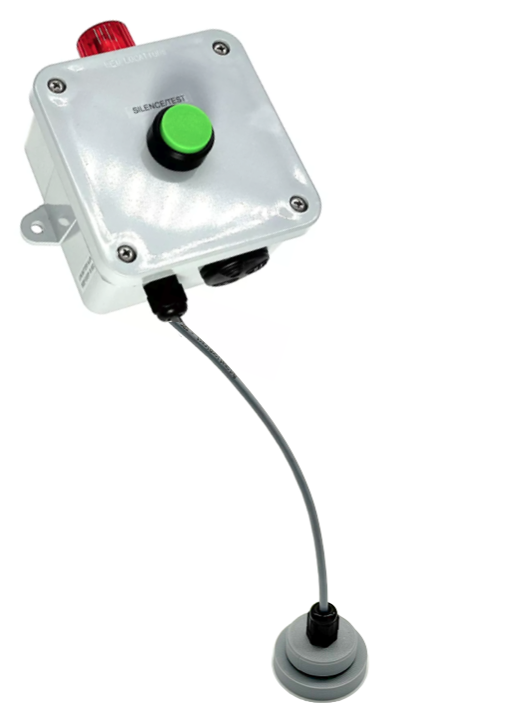
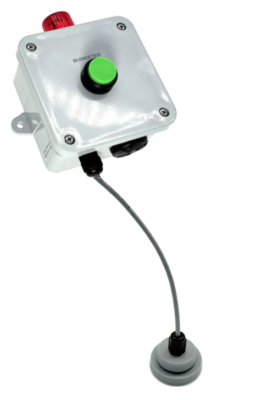
Leak Detection Alarm – Early Warning for Tank Leaks and Containment Pans
HOW THE LEAK ALARM WORKS
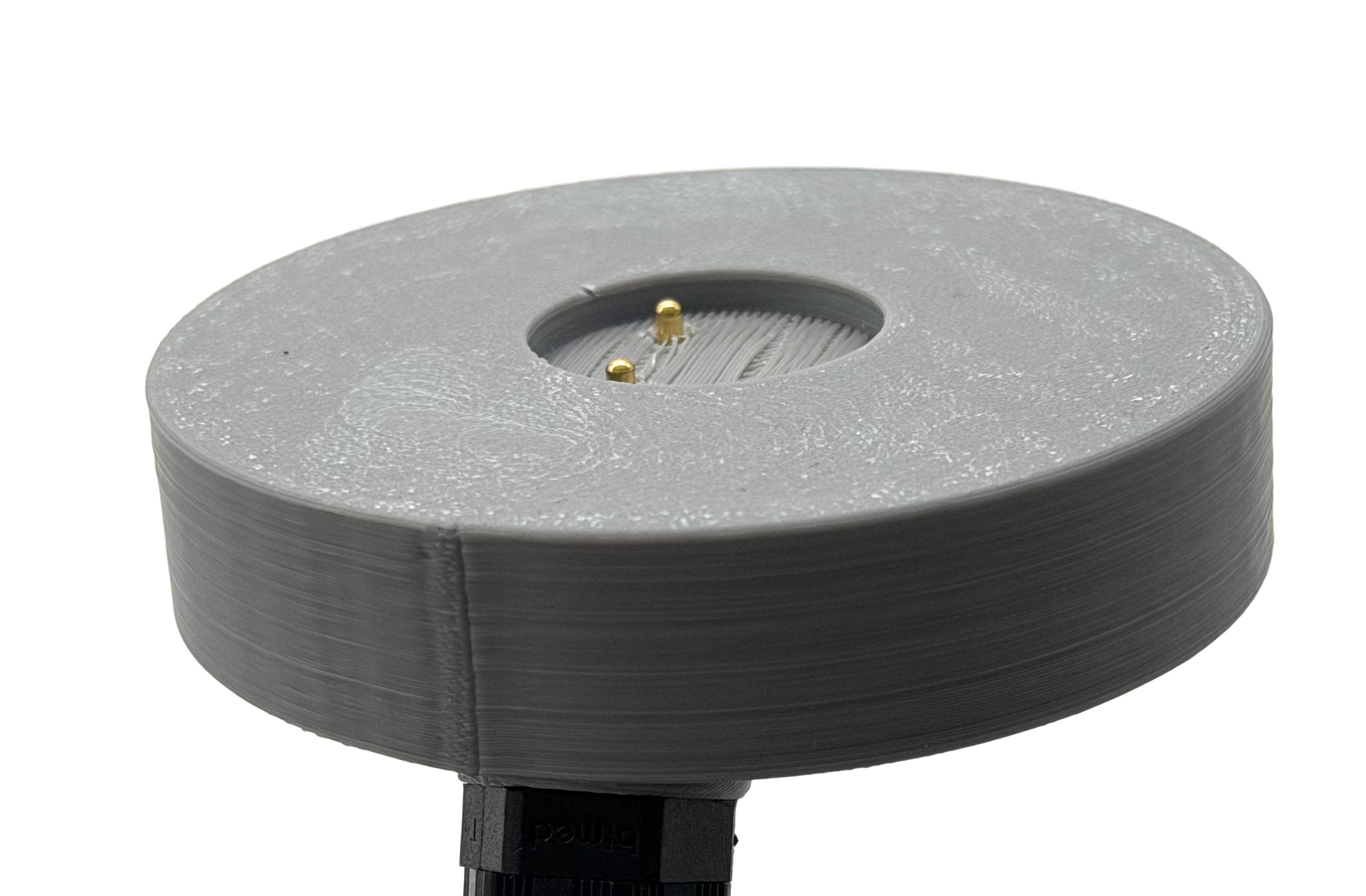
We use conductivity pins to detect liquid because nothing matches the precision of conductivity pins to detect a thin film of liquid at the bottom of a containment pan. This matters because detecting early can give a warning much earlier than other methods of detection. In addition, we use gold-plated pins that can’t corrode which provides maximum reliability. Since these pins can sit in place for a decade or more, it gives peace-of-mind to know that the gold surface is non-corroding.
Furthermore, the conductivity sensing technology allows the unit to be powered from a battery. Since the circuit operates at close to zero drain, it allows a battery to stay in place for a decade or more. This provides the reliability advantages and convenience of battery power. When the battery eventually runs, low, an alarm is given.
In addition to these advantages, the conductivity sensors require no calibration. (unlike some capacitance sensors for example)
The sensing pins are kept off the bottom by a couple of mm so as to eliminate false alerts that may be caused by condensation.
INSTALLATION
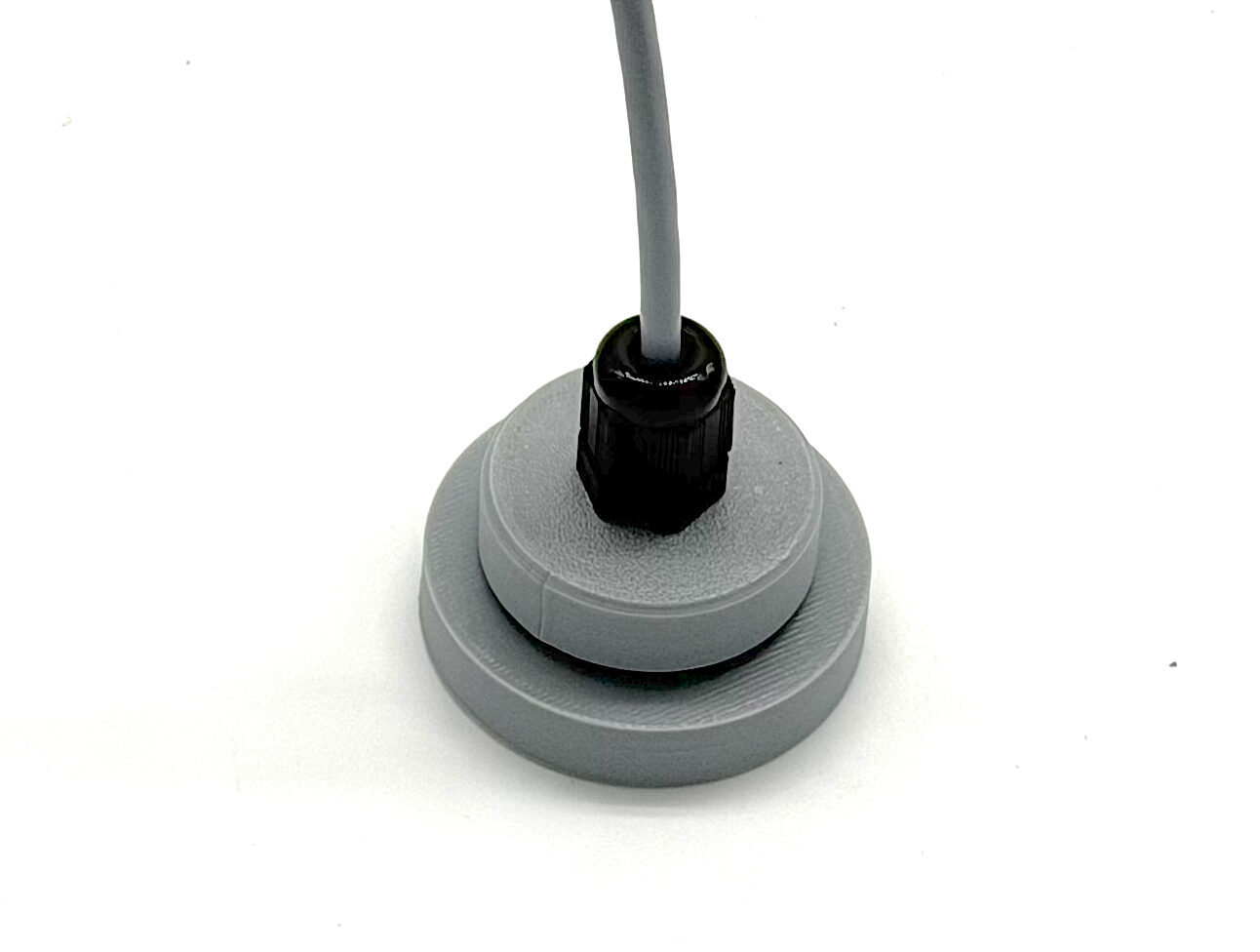
To install the device, the conductivity leak alarm just needs to be placed into the space where the leaks need to be detected. It is weighted to align itself so it sits flat. Super flexible cable makes this easy. There is nothing to calibrate or adjust.
NO MAINTAINANCE
There is is nothing to wear out and no moving parts to limit the lifetime of a conductivity sensor. The gold plated sensing pins are immune to corrosion.
OVERVIEW
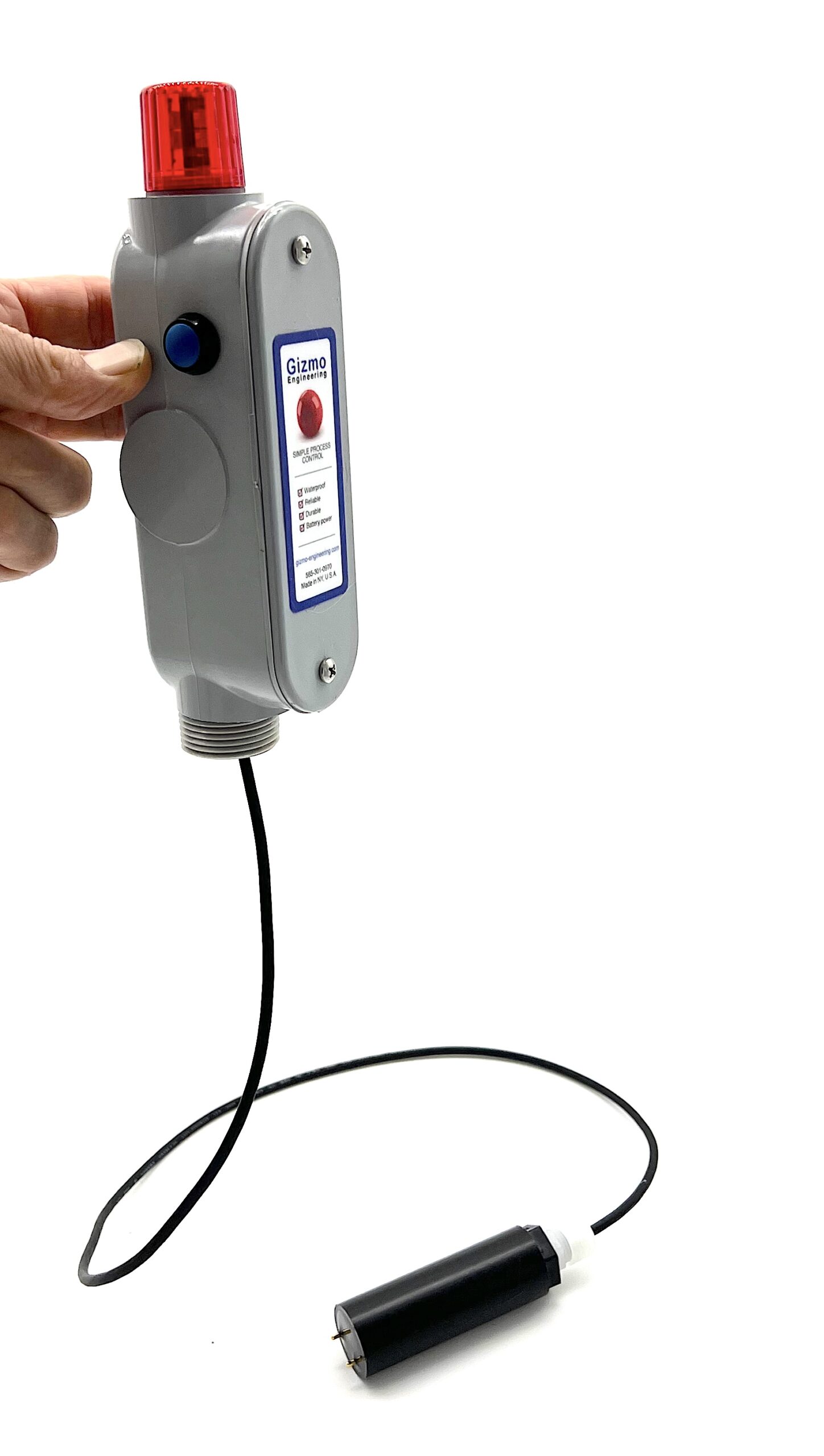
This high‑sensitivity leak detector provides early warning protection for tanks, containment pans, and critical chemical processes where even a small leak must be detected quickly. It produces a loud audible alarm and bright flashing LED when liquid is detected.
This leak detection system is ideal anywhere there should not be any liquid present in a containment area and an early leak warning is needed. Typical applications include:
- Secondary containment tanks and sumps beneath process tanks.
- Spill containment pans under chemical process equipment or pumps.
- Leak monitoring below storage tanks and totes where early warning is critical.
Instructions coming
Press Release coming
- Pipe material……………………………………… polypropylene
- Pipe O.D (¾” (sch 80)…………………………… 27 mm [1.06″]
- Maximum operating temperature………………190ºF
- Passive current……………………………………10 µA
- Buzzer volume……………………………………103dB @ 2ft
- Gold pin plating thickness………………………20 µ-inch [0.5 microns]
- Sensing distance (max.)…………………………< 1 mm
- Potting compound (surrounding pins……………epoxy Novolac resin
PDF of model T-LKP with tubular sensor
WETTED MATERIALS
POLYPROPYLENE MODELS
Pipe………………………………… Polypropylene
Lens…………………………………silica glass
Sealant………………………………epoxy Novolac resin
KYNAR MODELS
Pipe………………………………… PVDF (Kynar)
Lens…………………………………silica glass
Sealant………………………………epoxy Novolac resin
MODELS
Polypropylene Pipe
High level alarms………T-PC-[depth]
Low level alarms…………………T-PC-[depth]
Kynar Pipe
High level alarm…………………T-KC-[depth]
Low level alarm…………………T-KC-[depth]
Examples for Kynar pipe:
T-KC-10, T-KC-20, T-KC-30, T-KC-40, etc.

Order Here
Options
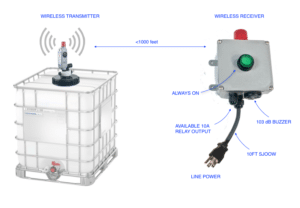
Wireless
On premises wireless communication includes a transmitter inside the level alarm. It sends a wireless signal to a receiver.
Buzzer is in the receiver instead of at the tank.
more info
[W2] $315
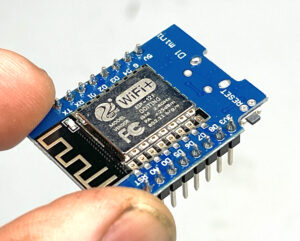
WIFI communication.
Sends a message to your email or text message to your phone. Easy setup. No recurring fees. More info.
[WF-1] $185